How to Measure Your Pupillary Distance at Home
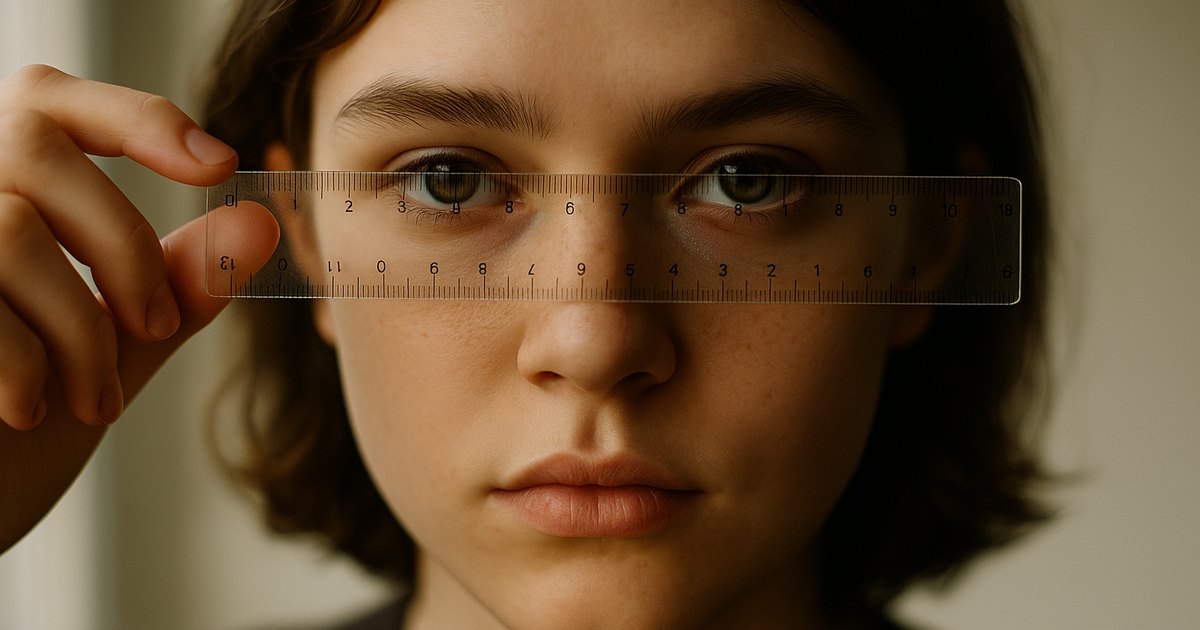
Your pupillary distance (PD) is the measurement in millimeters between the centers of your pupils. It is essential for ordering prescription glasses online because it tells the lab exactly where to place the optical center of each lens. If the PD is wrong, your lenses will not align with your eyes, causing discomfort and blurry vision. Here is how to measure it accurately at home.
What You Need
- A millimeter ruler (most rulers have mm markings on one side)
- A mirror, or a friend to help
- Good lighting
Method 1: Mirror Method (Solo)
- Stand about 8 inches (20 cm) from a mirror in a well-lit room.
- Hold the ruler flat against your brow, just above your eyes. The ruler should be level and not tilted.
- Close your right eye. Align the zero mark of the ruler with the center of your left pupil.
- Without moving the ruler, close your left eye and open your right eye.
- Read the millimeter mark that lines up with the center of your right pupil. That number is your PD.
- Repeat three times and take the average for accuracy.
This method works well for most people. The key is keeping the ruler perfectly still between steps 3 and 4. If the ruler shifts even slightly, your measurement will be off.
Method 2: Friend Method (More Accurate)
- Sit facing your friend at arm's length. You should be looking straight ahead at a distant object (not at your friend's face, which would cause your eyes to converge).
- Your friend holds the ruler across your brow and aligns the zero with the center of your left pupil.
- Without moving the ruler, they read the measurement at the center of your right pupil.
- Repeat three times and average.
Having a friend measure is generally more accurate because the person being measured can look straight ahead naturally without trying to read a ruler at the same time.
Method 3: Phone App
Several smartphone apps can measure PD using your phone camera and a reference object (like a credit card held to your forehead). Popular options include EyeMeasure (iOS) and GlassifyMe (Android/iOS). These typically achieve accuracy within 1-2mm, which is acceptable for single-vision lenses.
For progressive or bifocal lenses, you may need dual PD measurements (separate values for each eye), and the ruler method is more reliable for this purpose.
Single PD vs. Dual PD
A single PD is one number (e.g., 63mm) representing the total distance between your pupils. A dual PD gives separate measurements for each eye from the center of your nose (e.g., 31.5 / 32.0). Most faces are not perfectly symmetrical, so dual PD is slightly more precise.
For single-vision lenses, a single PD is usually sufficient. For progressive or bifocal lenses, dual PD is recommended because lens alignment is more critical with multi-focal designs. Read our progressive vs bifocal guide for more on multi-focal lenses.
Common Mistakes to Avoid
- Looking at the ruler instead of straight ahead. When your eyes focus on a close object, they converge inward, giving a smaller PD reading. Always look at a distant point.
- Tilting the ruler. Even a slight angle changes the reading. Keep it level and flat across your brow.
- Measuring once. Always measure at least three times and average the results. Individual measurements can vary by 1-2mm due to slight movements.
- Confusing mm and cm. PD is always in millimeters. A typical PD is 60-70 mm, not 6-7 cm (even though those are the same number, entering "6.3" instead of "63" will result in an error or unusable glasses).
What If My Optometrist Will Not Give Me My PD?
Some optometrists are reluctant to provide PD measurements because they know it enables you to buy glasses online. In most US states, optometrists are required to release your prescription on request (under the FTC Eyeglass Rule), but PD is not technically part of the prescription, so they are not obligated to provide it.
Your options: measure at home using the methods above, use a phone app, or visit a different optician and ask for a PD measurement (some will do it for free or a small fee).
Ready to Order?
Once you have your PD, you are ready to order prescription glasses online. Most retailers ask for your PD during checkout. If you need frame recommendations, browse our eyeglasses collection or check current deals and discounts.
Got your PD? Start shopping for frames.
Browse Frames →Sources and further reading
Independent references for checking the safety, rules and buying details covered in this guide. We are not affiliated with these organizations.
Frequently Asked Questions
- What is a normal PD measurement?
- Adult PD typically ranges from 54 to 74 mm, with the average being about 63 mm for men and 62 mm for women. Children's PD ranges from about 43 to 58 mm.
- Why is PD not on my prescription?
- Many optometrists do not include PD on prescriptions because it is not legally required in most states and they prefer you buy glasses from their optical shop.
- Can I measure PD with my phone?
- Yes. Several apps use your phone camera to measure PD. They are reasonably accurate for single-vision lenses, though manual measurement with a ruler is often more reliable for progressive lenses.
- What happens if my PD is wrong?
- An incorrect PD shifts the optical center of your lenses away from your pupils. Small errors of 1-2mm are usually tolerable. Larger errors cause eye strain, headaches, and blurry vision.